
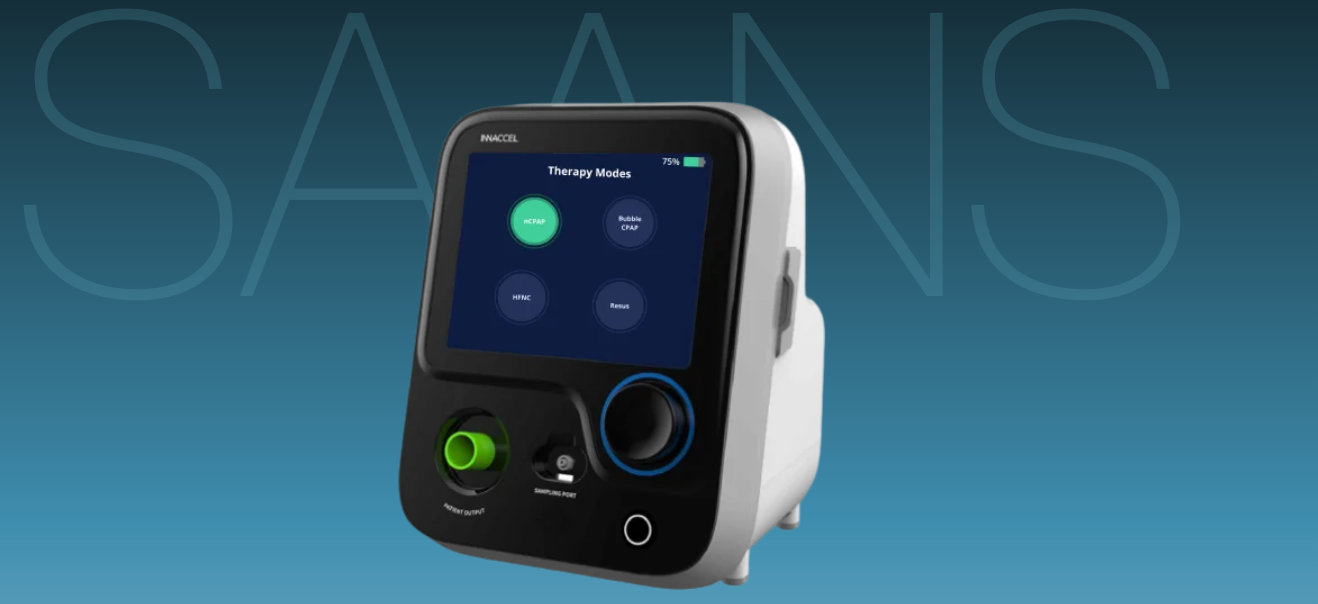
Respiratory complications remain one of the leading causes of mortality among newborns and young children worldwide. Many infants, especially premature babies, struggle with breathing difficulties immediately after birth and require timely respiratory support to survive. While advanced breathing support technologies exist, access to these life-saving systems is often limited to well-equipped tertiary hospitals and neonatal intensive care units (NICUs).
To address this critical healthcare gap, Saans, an intelligent breathing support system, has been developed to provide effective non-invasive respiratory support for neonatal and pediatric patients across a wide range of clinical and transport settings. Designed to be infrastructure-independent and easy to deploy, Saans is transforming the way healthcare providers deliver respiratory care to newborns and children.
The Global Challenge of Neonatal Respiratory Distress
Every year, millions of newborns worldwide experience respiratory complications, which can be caused by conditions such as:
-
Respiratory Distress Syndrome (RDS)
-
Birth asphyxia
-
Pneumonia or infection
-
Prematurity-related lung immaturity
Without proper breathing support, these conditions can quickly become life-threatening. In many developing regions, hospitals and healthcare facilities often lack advanced respiratory support systems, trained personnel, or specialized neonatal care units. As a result, many newborns who could potentially survive with timely intervention do not receive the required treatment.
This is where intelligent and accessible medical technologies like Saans play a crucial role.
What is Saans?
Saans is an intelligent, multi-therapy breathing support system designed specifically for neonatal and pediatric patients. The system provides non-invasive respiratory support, helping babies and young children breathe more effectively without the need for invasive procedures.
One of the key advantages of Saans is that it is infrastructure-independent, meaning it can function efficiently even in healthcare environments where advanced ICU infrastructure may not be available.
The device is designed to deliver respiratory support in:
-
Neonatal care units
-
Pediatric wards
-
Emergency rooms
-
Smaller hospitals and clinics
-
Ambulances and transport environments
By offering flexibility and portability, Saans ensures that breathing support can be provided wherever it is needed most.
Intelligent Non-Invasive Breathing Support
Traditional respiratory support systems in hospitals often require complex setups and specialized equipment. In contrast, Saans uses non-invasive respiratory support techniques, which are safer and more comfortable for newborns and pediatric patients.
Non-invasive breathing support helps in:
-
Maintaining airway pressure
-
Improving oxygen delivery to the lungs
-
Reducing breathing effort in newborns
-
Preventing lung collapse
-
Stabilizing patients with respiratory distress
Because the system does not require invasive procedures such as intubation, it significantly reduces the risk of complications and infections.
The intelligent design of Saans allows healthcare providers to deliver effective respiratory therapy while maintaining patient safety and comfort.
Multi-Therapy System for Comprehensive Care
One of the most important features of Saans is its multi-therapy capability. Unlike conventional respiratory devices that provide only a single therapy mode, Saans is designed to support multiple breathing therapies for neonatal and pediatric patients.
This flexibility enables healthcare professionals to adjust treatment according to the patient’s condition and severity of respiratory distress. As a result, clinicians can deliver more personalized and effective respiratory care.
The ability to support multiple therapies within one system also reduces the need for multiple devices, simplifying neonatal care workflows in hospitals and clinics.
Supporting Care Beyond the NICU
Many life-saving medical technologies are limited to large tertiary hospitals, leaving smaller healthcare facilities without access to advanced treatments. Saans addresses this challenge by enabling respiratory support beyond traditional NICU environments.
Because the system is infrastructure-independent, it can be used in healthcare settings such as:
-
District hospitals
-
Rural healthcare centers
-
Community hospitals
-
Emergency care facilities
This expands the reach of neonatal respiratory support to areas where specialized medical infrastructure may not be available.
By enabling early respiratory intervention, Saans helps prevent complications and improves survival rates among newborns and children.
Enabling Safe Neonatal and Pediatric Transport
Transporting critically ill newborns between healthcare facilities is often a challenging and risky process. During transport, maintaining stable respiratory support is crucial to prevent deterioration of the patient’s condition.
Saans plays a vital role in neonatal and pediatric transport care. Its portable and intelligent design allows healthcare providers to deliver consistent breathing support even while transferring patients between hospitals.
This capability ensures that infants and children continue to receive the necessary respiratory therapy throughout the transport process, significantly improving patient safety.
Improving Outcomes for Newborns and Children
Early and effective respiratory intervention can dramatically improve survival rates and long-term health outcomes for newborns and pediatric patients. Saans helps healthcare providers deliver timely breathing support, which can:
-
Stabilize infants with respiratory distress
-
Reduce the need for invasive ventilation
-
Improve oxygenation levels
-
Prevent complications related to delayed treatment
By making respiratory therapy more accessible and efficient, Saans contributes to better neonatal and pediatric care outcomes across different healthcare settings.
The Future of Neonatal Respiratory Care
The future of healthcare lies in developing technologies that are not only advanced but also accessible. Medical devices that are easy to use, portable, and adaptable to different clinical environments will play a major role in improving patient care worldwide.
Saans represents a significant step forward in neonatal and pediatric respiratory support. By combining intelligent design with non-invasive therapy and infrastructure independence, the system enables healthcare providers to deliver life-saving respiratory care to more patients.
Conclusion
Respiratory distress continues to be a major challenge in neonatal and pediatric healthcare. Access to effective breathing support can mean the difference between life and death for many newborns and young children.
Saans, an intelligent multi-therapy breathing support system, is helping transform respiratory care by making non-invasive breathing support accessible across hospitals, clinics, and transport environments. Its infrastructure-independent design, portability, and advanced functionality allow healthcare providers to deliver timely and effective respiratory therapy wherever it is needed.
By expanding access to life-saving breathing support, Saans is playing an important role in improving survival rates and shaping the future of neonatal and pediatric healthcare.


