
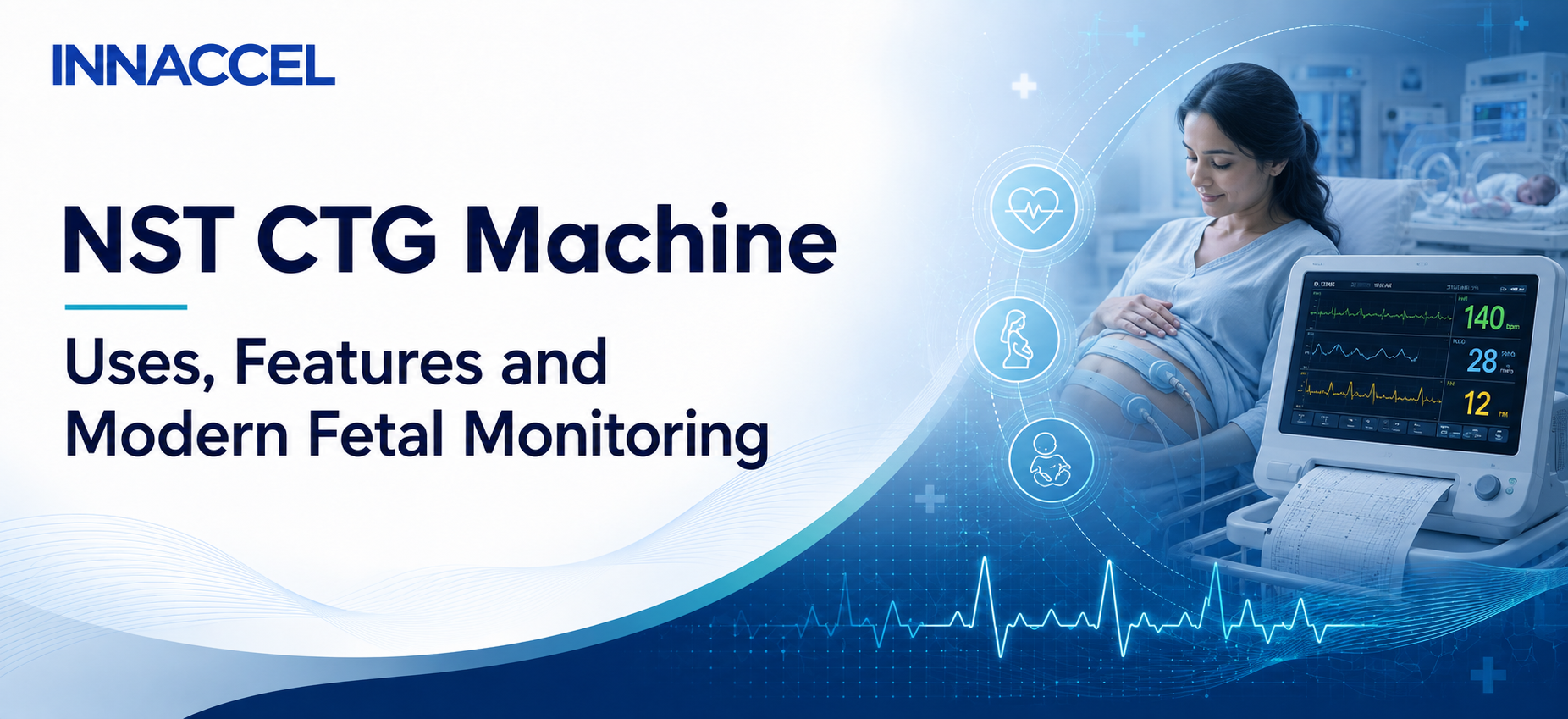
Fetal monitoring supports clinical assessment during pregnancy and labour, but the terminology used around non-stress testing and cardiotocography is often applied too broadly. Although “NST” and “CTG” may be used interchangeably in everyday discussion, they describe related but clinically distinct applications. Using the correct term is important when explaining the purpose of a device, the parameters being recorded and the setting in which monitoring takes place.
An NST primarily refers to antenatal assessment of the fetal heart-rate response to movement before labour. An NST CTG machine, by contrast, refers to a cardiotocography configuration that records fetal heart rate together with uterine activity through a TOCO channel. This dual-trace capability is particularly relevant when clinicians need to evaluate the fetal heart-rate pattern alongside contractions, including during labour.
| Clinical terminology note
NST: An antenatal fetal surveillance test focused on fetal heart-rate response without deliberately stressing the fetus. TOCO is not the defining element of the test. NST CTG / CTG: A monitoring configuration that records fetal heart rate and uterine activity, providing a combined trace for clinical assessment, commonly including use during labour. |
What Is an NST CTG Machine?
An NST CTG machine is a fetal monitoring system designed to record fetal heart rate and uterine activity as separate but synchronised traces. A conventional configuration typically includes a Doppler-based fetal-heart-rate probe, a TOCO transducer for uterine activity, a display and a mechanism for storing or printing the trace. Some systems may also support maternal heart-rate monitoring, twin monitoring, wireless probes or digital data transfer.
The fetal-heart-rate channel helps clinicians evaluate the baseline rate, variability, accelerations and decelerations. The TOCO channel records changes in abdominal surface tension associated with uterine activity. When these signals are viewed together, healthcare professionals can assess how the fetal heart-rate pattern relates to contractions and the broader clinical situation.
NST Before Labour: Antenatal Fetal Surveillance
A non-stress test is performed before labour as part of antenatal fetal surveillance. Its purpose is to observe how the fetal heart rate responds to spontaneous fetal movement over a defined monitoring period. The term “non-stress” indicates that the test does not deliberately induce uterine contractions or otherwise place stress on the fetus.
An antenatal NST may be recommended when there are concerns such as reduced fetal movement, pregnancy beyond the expected due date, maternal medical conditions, multiple pregnancy, suspected fetal growth concerns or other high-risk factors. The result may be described as reactive or non-reactive, but interpretation and any subsequent action must be determined by a qualified obstetric or maternity-care professional in the context of the complete clinical picture.
For accuracy in product communication, an NST should not automatically be described as a test that requires TOCO monitoring. The defining assessment is the fetal heart-rate response. A device may include a TOCO channel, but that additional capability moves the equipment description toward NST CTG or full CTG functionality.
CTG During Labour: Fetal Heart Rate and Contraction Monitoring
Cardiotocography is commonly used during labour when simultaneous monitoring of the fetal heart rate and uterine contractions is clinically indicated. The combined trace allows the clinical team to review changes in fetal heart-rate behaviour in relation to the frequency and pattern of contractions.
CTG interpretation involves more than reading a single number. Clinicians assess the baseline fetal heart rate, variability, accelerations, decelerations and contraction pattern while also considering labour progress, maternal observations and relevant antenatal or intrapartum risk factors. The trace is therefore one component of a wider clinical assessment rather than a standalone diagnosis.
Why the Distinction Matters for Hospitals and Patients
Clear terminology helps hospitals select the right monitoring equipment and enables patients to better understand why a test is being performed. A facility seeking a system for antenatal non-stress testing may prioritise reliable fetal-heart-rate acquisition, portability and efficient documentation. A labour ward requiring CTG functionality will also need dependable uterine-activity monitoring, clear dual-trace display, alarms and workflow support for continuous or repeated monitoring.
Using “NST CTG machine” as the primary equipment term is more precise when a product includes both Doppler fetal-heart-rate and TOCO probes. It acknowledges the antenatal use associated with NST while correctly describing the broader CTG capability of recording fetal heart rate and uterine activity together.
Common Limitations of Conventional NST CTG Systems
Traditional fetal monitors remain central to maternity care, but they can present practical challenges. Large fixed systems may be difficult to move between outpatient departments, antenatal wards and labour rooms. Wired probes can restrict mobility, while changes in maternal position or fetal position may require probe adjustment. Paper-based records can also make remote review, long-term storage and continuity of documentation more difficult.
These limitations are particularly relevant in busy maternity units, smaller hospitals, outreach programmes and healthcare facilities where space, power availability or specialist staffing may be constrained. As a result, hospitals increasingly look for an NST CTG machine that combines dependable signal acquisition with portability, wireless operation and digital data tools.
Fetal Lite NST CTG by InnAccel Technologies
InnAccel Technologies has developed Fetal Lite, a portable and wireless fetal monitoring platform intended to expand access to digitally connected maternal-care technology. The Fetal Lite NST CTG configuration uses traditional Doppler-based fetal-heart-rate and TOCO probes and is indicated by the manufacturer for monitoring after 24 weeks of gestation. A twin-monitoring probe is available as an add-on.
The platform includes digital tools that support scan storage, remote data access and connected workflows. Depending on the selected configuration, features may include wireless operation, an in-built printer and portable charging. These capabilities can help reduce dependence on large fixed installations and make fetal monitoring more practical across different areas of a healthcare facility.
Fetal Lite is also available in the Fetal Lite SU configuration, which uses a single ECG/EMG extraction-based probe to monitor fetal heart rate, maternal heart rate and uterine activity after 36 weeks of pregnancy. The availability of different configurations allows healthcare providers to select a system according to gestational age, monitoring requirements and institutional workflow.
Important Features to Consider in an NST CTG Machine
- Reliable signal acquisition: The system should consistently acquire fetal-heart-rate and uterine-activity signals suitable for interpretation by trained clinicians.
- Dual-trace monitoring: A clear display of fetal heart rate and TOCO information helps clinicians assess their relationship over time.
- Portability: A lightweight system can be moved between antenatal clinics, maternity wards, labour rooms and outreach settings.
- Wireless operation: Wireless probes can reduce cable-related restrictions and support a more flexible monitoring environment.
- Digital documentation: Storage, printing and remote access can improve record management, review and continuity of care.
- Power flexibility: Battery or portable charging options are valuable where uninterrupted mains electricity cannot be assumed.
- Training and service support: Installation, user training, preventive maintenance and responsive technical support should be included in procurement decisions.
Supporting the Maternal, Neonatal and Critical-Care Continuum
Fetal monitoring is one part of a wider care pathway that can extend from pregnancy assessment and labour to newborn stabilisation and intensive care. InnAccel Technologies develops solutions across maternal, neonatal, paediatric and critical-care environments.
For newborns and children requiring non-invasive respiratory support, the SAANS System combines Bubble CPAP, nasal CPAP, HFNC and resuscitation support in a portable platform with oxygen-source compatibility and battery backup for clinical and transport applications.
In critical care, VapCare is an automated oral-hygiene and secretion-management system developed for mechanically ventilated ICU patients. It supports automated secretion clearance and oral lavage, helping standardise important bedside care processes.
Choosing the Right NST CTG Machine
Hospitals should evaluate an NST CTG machine according to the clinical setting, expected patient volume, gestational-age requirements, mobility needs and the experience of intended users. Procurement teams should also review regulatory status, clinical evidence, consumables, maintenance requirements, data-management capability, training and after-sales support.
A practical product demonstration can help clinicians and administrators evaluate signal acquisition, probe placement, user-interface clarity, printing and storage, wireless performance and ease of movement between departments. The final selection should always match institutional protocols and the intended clinical use.
Conclusion
NST and CTG are closely related concepts, but they should not be treated as identical. An NST is principally an antenatal assessment of fetal heart-rate response before labour, while CTG records fetal heart rate together with uterine activity and is commonly used when contraction monitoring is required, including during labour. The term “NST CTG machine” is therefore appropriate for equipment that combines Doppler fetal-heart-rate monitoring with a TOCO channel.
Through Fetal Lite NST CTG, InnAccel Technologies offers a portable and digitally connected monitoring configuration designed for use after 24 weeks of gestation. Together with SAANS for neonatal and paediatric respiratory support and VapCare for critical care, the company is building medical technologies that support important stages of the maternal and hospital-care continuum.


